Museum Home - Rugby Relics Home
WALES v ALL BLACKS
1905 - 16th December - WALES 3, NEW ZEALAND 0 (Cardiff Arms Park)
|
|
|
|
They were the greatest
team ever to visit the EARLY
DAYS of the TOUR The All Blacks arrived
in Britain after 40 days aboard the SS Rimutaka. With nothing to do on
board but
play cards and train, the 'Originals' honed their rugby skills and tactics to perfection under
coach Jimmy Duncan. Duncan was an All Black veteran, captain of the
first ever All Black test side and an astute tactician. After a week
finding their land legs in Newton Abbot, they were set to face England’s champion county
Devon
at Exeter. The critics suggested the ‘colonial’ team would struggle against
the West countrymen but the All Blacks thumped Devon
by 55 points to 4, Cornwall were next, then Bristol, Northampton &
Leicester, in their first five matches the All Blacks scored 197 points
with just 4 against. News soon spread of this fantastic team, the qualities of the
All Black scrum, the fitness of the players and the role of the
forwards, who unprecedented at the time even joined in passing movements with the backs. They blazed a trail through
England, Scotland
& Ireland, defeating clubs, counties and countries alike ! ALL BLACK SUPREMACY The foundation on which the All Blacks built their victories was the scrum. The rules at that time relating to the scrum were not complex, the laws of the day described it thus
There were penalties for picking the ball up, a crooked feed and foot up, the number of players however, remained at the discretion of the participating teams. The All Black’s had honed their scrummaging skills almost to perfection. Their success was due to their scrum formation and tactics, only seven New Zealand men packed down against the opposition’s eight but with careful manoeuvring they could engage their seven man shove against only half of the opposing pack, Gallaher in his post tour book called it a ‘wedge formation’. The rule of thumb for British teams was that the forwards packed down as they arrived at the scrummage in a 3 -2 - 3 formation. It was first to arrive was first to pack, a forward could find himself in the front row of the scrum and in the next the back row, the British scrum was haphazard. The All Blacks had a system whereby each man took the same place at each scrum according to his physical characteristics and skills. Some of the names of today’s scrummaging positions derive from ‘the orignals’ scrum. The front row comprised of two hookers, responsible for hooking the ball, then came a ‘lock’ in the second row, with two ‘side men’, two back row men completed the scrum. It’s ‘crowning glory’ was that the two hookers fought tooth and nail to gain the ‘loose head’, once gained, the wedge formation drove against one side of the opposition scrum, either pushing them off the ball or turning the scrum. The photograph below shows the Middlesex match, the nearside Middlesex front row forward has nothing to push against and is turned sideways while the ball is being channelled nicely to the waiting Roberts. The ball has been put into the scrum by Gallaher who is unsighted behind the scrum. Co-incidentally 2 of the Welsh forwards played in this match, Jack Williams and Arthur Harding, both London based Welshmen packed down against the New Zealand seven.
Middlesex v All Blacks |
|
|
|
|
|
The above formation shows the positioning of the players, by gaining the loose head with the two man front row formation, the All Blacks cancelled out the shove of 3 of the opposing pack's players, we have marked these players with red crosses.
|
|
|
The All Blacks backed up the scrum with
mobile forwards that received and gave passes, winning the majority of the
ball the tourists run riot with
opposition defences sometimes running the ball from their own line,
unheard of in the early 1900s. They had superior fitness, skills and tactical
awareness which meant they were untouchable in
the early part of the tour. THE WELSH BUILD UP The possibility that the All Blacks would be too strong for Wales made the Union sit up and take notice, the match committee were sent to Gloucester on October 19th to watch the visitors triumph 44-0 over the much fancied local team. The ‘colonials’ methods were noted and the Welshmen returned home to prepare for the big day. Two trials were held to find the 15 men with the task of defeating the tourists. The first on the 20th November saw several leading players missing, the favoured XV 'the Probables played with the New Zealand seven formation and were beaten 18 points to 9. The second trial took place on December 2nd only two weeks prior to the match, this time the 'Probables' won 33 points to 11, still experimenting with the All Black scrum formation. The Thursday (7 December) following this trial 13 of the selected players took part in a training session under the direction of scrum half Dicky Owen, this session concentrated mostly on the backs and in all probability was where the move that led to the try was practised. The second session on the following Tuesday, December 12th was dedicated to drop kicking and the scrum, 'Old Stager' the leading journalist of the day hinted to his readers that something new was in the offing. The Welsh public would have to wait until Saturday to find out what. THE ALL BLACKS BUILD UP The All Blacks continued
their rout, prior to arriving in Cardiff, they had played 600 minutes of rugby without conceding a
point, No team had scored a single point against them in the last 7 and a
half matches. These included the defeats of both England
and Ireland, both by the score of 15 - 0. This was a team on a roll. PRE-MATCH The 16th December arrived, special trains had been laid on for spectators from afar, queues formed at the gates and once opened around 11.00 am the ground quickly filled, at 1.30 pm the gates were closed. Those inside sang and joked while the unfortunate locked out looked for trees to climb and other vantage points. At 2.20 pm the All Blacks took to the field followed a little later by the Welsh team, the crowd roar was almost deafening as Nicholls led his men onto the Park. The All Blacks performed their customary haka then unusually the Welsh team started to sing the national anthem, this was soon picked up by the crowd and soon the whole stadium reverberated to the sounds of ‘Hen Wlad Fy Nhadau’. |
|
|
PRE-MATCH PREVIEW BY THE TIMES The following extracts are verbatim reports from The Times, it wouldn't suprise me if the 'correspondent' who wrote 'the Revolution in Rugby Union' is still eating his words..................... FOOTBALL The New Zealanders make their first appearance before a Welsh crowd, at Cardiff, this afternoon, when they will be opposed in the last of their representative games by Wales. The match is being eagerly looked forward to and, although the Cardiff Arms-park can accommodate 40,000 people, it is estimated that almost double that number of spectators will want to witness the game. The sides will be:- (teams as selected listed here) THE
REVOLUTION IN RUGBY UNION Wales is the only portion of the United Kingdom in which Rugby Union football is the national game (as it is in New Zealand), and it would be a kind of poetic justice if the victorious progress of the New Zealand team were checked at Cardiff to-day. But, to judge by the indifferent exhibition of the Welsh three-quarters on the Rectory Field last week, the defeat of the visitors is an unthinkable contingency. The famous three-quarter line has aged somewhat since I saw it a year ago, the effect of the efflux of time being most obvious in the case of and no longer possesses that instinct for position which, in the Rugby game, is always the prerogative of youth. Formerly he was the soul of his line of offence and defence, which, now that he has fallen into the ruck of international three-quarters, is a machine rather than an organism. Again and again last Saturday the Welsh back-play merely transferred the ball straight across the field, and the co-operation between the centre three-quarters - a Welsh device comparable at times in its results with the ''three insides'' combination in the Association game- was just a little too slow to be effective. It is a pity that the Welsh authorities had not the courage either to adhere to their own formation in choosing the 15 against New Zealand or to adopt that of the visitors. A ''flying'' back, even if he labours as lustily as he did the brilliantly eccentric Raphael in the New Zealand V. England match, cannot be a part of the combination in attack- for nobody knows where a pass will find him- and is a source of confusion even if his spoiling tactics are successful. This year the Welsh forwards are not as good as they were in 1904-5-time has stolen the dash from two or three of the best-and the missing eighth man is likely to be badly missed before the Cardiff game comes to its conclusion in the inevitable defeat Wales. None of the Welsh club teams, to take a line through the achievements of Gloucester, Devonport Albion, and Bristol, has the faintest chance of scoring a victory, and the only consolation for the players of Rugby Union in this country will be found in the inability of the ''silver fern'' to score a full thousand points in the course of their tour.
THE TEAMS WALES
NEW ZEALAND THE MATCH Hodges kicked off for Wales and finally the match was underway and the question of who was the ‘greatest’ would soon be answered. Play was hard, Seeling made a burst upfield, he was brought down and a scrum given. The All Blacks formed up and expected the usual seven against eight. The Welsh had however done their homework and were forming their scrum differently with seven men instead of the normal eight and unusually there were four men in the front row. Only the middle two Welsh players made ready to engage the All Black hookers and as the front rows met the outside Welshman engaged the scrum, while the surplus player on the other side retired into the second row. The men in scarlet had outwitted the All Blacks, stolen the loose head and would continue to do so for the rest of the afternoon.
|
|
|
All Blacks engage to the right, Harding packs down in
the front row while Jones retires and packs down with the remainder of the
pack in the second row, there was no back row.
|
All Blacks engage to the left, Jones packs down in the
front row while Harding retires and packs down with the remainder of the
pack in the second row, there was no back row.
|
|
With the loose head won on each scrum Wales started to put the All Blacks under pressure and almost went ahead through Willie Llewellyn, but unfortunately the London Welshman dropped the ball after an awkward pass from Jack Williams with the line just yards away. Then after 23 minutes the All Black line was crossed as Teddy Morgan scored the only points of the game. THE
TRY The Welsh try was a pre-conceived move, thought up by the ‘pocket rocket’ Dicky Owen and practised in the training sessions prior to the game. In a feint to the blindside where Bush, Nicholls & Llewellyn lined up, drawing the NZ defence, the diminutive Owen suddenly changed direction and sent out a long pass to the openside, Cliff Pritchard scooped the ball up off his feet, he then drew Deans and fed to Rhys Gabe, McGregor was drawn and Gabe offloaded to Teddy Morgan, Morgan outstripped the covering full-back Gillett to race away into the corner for the game’s solitary score. The game continued with both teams capable of scoring, the closest opportunity came for the All Blacks when three-quarter Bob Deans was brought down inches from the line. Deans maintained until the day he died that he had scored on the day and the Welsh try scorer Teddy Morgan years later agreed. Morgan also claimed to have brought Deans down but the 'honour' of the try saving tackle fell to Rhys Gabe. Gabe recalled the incident in an article prior to the 1963 match.
POST MATCH The final whistle went, Wales had won, the crowd rushed the field and carried the Welsh players shoulder high from the field. The All Blacks dejected made their way back to the changing sheds, later Gallaher led his men to the Welsh changing room where he swapped jerseys with Nicholls, the teams then exchanged jerseys en masse. MATCH REPORT BY THE TIMES FOOTBALL -
RUGBY UNION RULES
WALES V. THE NEW ZEALANDERS FIRST DEFEAT OF THE ZEALANDERS The Welsh fifteen beat the New Zealanders, at Cardiff on Saturday, by one try to nothing. It was the first defeat of the New Zealanders, whose long sequence of victories had established with them such a habit of winning that it was difficult to realize that they had at last experienced defeat. Wales won only after a very severe struggle, and even in the last ten minutes the New Zealanders, as at Inverleith, came near to winning the game on the post. The two great factors in the Welsh victory were the unyielding nature of the forwards and the accurate kicking of H. B. Winfield, the full back. It may be laid down at once that Wales beat the New Zealanders at their own game, for the Welshman not only threw out a dashing flying man, but, abandoning their own particular four three-quarters system, went in for strong individual play. They set a wonderful pace at the start, maintained it to the end, and with the turn of the luck just won. The football was the hardest imaginable. Virtually it resolved itself into a tremendous battle between two sets of determined forwards, for the game outside the scrummage was comparatively little else than by-play. In the robustness and fierceness of the forward work there was no room left for a display of the finer arts of the game. Thus, behind the Welsh pack Cliff Pritchard, as flying man, fulfilled his duties, with an execution that few could have thought possible against the New Zealanders; R. M. Owen, as the genuine half-back, ''worked'' the scrummage with a skill and a courage that were wonderful against the strenuous forwards; and then Percy Bush, Gwyn Nicholls, and R. T Gabe, when they got the ball usually went on and, when checked, finished by finding touch. Thus there were few of those wonderful movements characteristic of the Welsh system. There were two or three exceptions, particularly that which led up to the E. T. Morgan's try when the game was about 30 minutes old. But the Welshman made no pretence of playing their orthodox game. They had thought out new devices for combating the New Zealanders' extended attack, and these succeeded excellently. Everything depended in the first instance on the forwards. Would they hold the scrummage? Would they get the ball? were questions commonly asked before the game. The affirmative answers came in the early moments of the match. The forwards had the industry of the Scottish, at Inverleith, and the dash of the Irish, and the Lansdowne road, combined. Their scrummage work was wonderful. They often got the ball and heeled quickly; they broke at once and followed up, and their tackling was relentlessly severe. The New Zealanders were not much behind them in pace, in keenness, or in getting a fair share of the ball. But the New Zealanders were not so expert in their actual footwork. The Welshmen had other advantages. They were splendidly served by their full back, who consistent length in kicking never faltered. Such kicking as this of H. B Winfield has rarely been equalled in a representative match; it can never have been surpassed; and the effect of all this wonderful play by Winfield was the immense economy in energy of the forwards. While the Welshman were so well served in this respect, the failure of the visitors' backs to do more than send the ball up the field meant that the New Zealanders' forwards were run off their legs. But there were other causes for the failure of the New Zealanders. The most obvious of all was the inability developed by the five-eights- H. J. Mynott and J. Hunter- to field the passes from F. Roberts, the New Zealanders' half back. Roberts played as brilliantly as ever in getting the ball and in passing quickly; but neither Mynott nor Hunter seemed capable of fielding it, and when they succeeded it was only to give slow lobbing passes that were usually intercepted by Cliff Pritchard. This breakdown in the New Zealand game behind spelt to the attack, which is absolutely dependent on the pivot furnished by the five-eighths for the three-quarters, and so beyond defensive work W. J. Wallace and D. Macgregor on the wings had very little to do until late in the game. Roberts, indeed, became so weary of fruitlessly feeding the five-eighths that in the second half of the match he took to going on himself with the ball, with the result very largely that thereafter the New Zealanders did the preponderant share of the attacking. G. Gillett, the full back, fielded the back badly, and never got any length on his kicking; his punts up the field would have ruined any side. In short, the New Zealanders played much below their best form, and those who saw the work of the backs could scarcely believe that this was the side that had come away from Scotland and Ireland with so many honours, The New Zealanders left the most severe portion of their tour too late, for the side is evidently feeling the effects of three months' hard football, to say nothing of having lost through injuries their chief attacking three-quarter, G. W. Smith. That Wales deserved to win on the run of the game is beyond question. The New Zealanders never looked like scoring in the first half, during which the play was only once in the home twenty-five and in that case only for a moment before the interval. In the second half of the game, however, the New Zealanders had their chances; but there was no fortune for them, Wallace crossed the line only to be called back for having gone into touch, and in another instance a forward pass by R. G. Deans prevented the completion of an inevitable try by D. Macgregor. Then when the ball was in a series of scrummages all along the Welsh goal line the superb tackling of the Welshmen prevailed. So the match was decided by the try which E. T. Morgan scored at the end of some 30 minutes; it was splendidly executed movement that led to it, and R. T Gabe's subtle tactics in drawing the remnants of the defence had most to do with the scoring. For robustness and keenness the game could not be surpassed. Mr. John D. Dallas, the referee nominated by the Scottish Union, had a very difficult task to perform. He administered the laws of the game unflinchingly, and the New Zealanders had to pay dearly for sailing so near the wind on the question of off-side. The many penalties given against them in the first quarter of an hour of the game obviously affected their organisation, and the pace and vigour of the Welsh forwards gave them no repose in which to steady themselves. There was a large company at the Cardiff ground, estimated roughly at 45,000, and the conditions generally were admirable. Those familiar with the Welsh character can readily depict the scenes of enthusiasm which the victory of Wales created. This was only the fourth try made against the New Zealanders in the tour, and the record is still 99 goals and 105 tries for them and only four goals and three tries against them (three of the goals were other than from the try). The teams were as follows :- (teams as selected listed here)
THE TOUR CONTINUES The All Blacks continued their tour with a further 4 matches in Wales and were extremely fortunate to come away without a further loss. In the week following the international they defeated Glamorgan 9 - 0, won by a narrow margin 6 - 3 at Rodney Parade, Newport. On Boxing Day the All Blacks defeated Cardiff 10 - 8, at 5 points apiece, Percy Bush gifted the tourists a try, Cardiff fought back with a score but the missed conversion saw Cardiff beaten. In this match the Blue & Blacks were the only team to score two tries against the All Blacks during the tour. The tourists last match in Wales was a hard fought 4 - 3 victory over Swansea where Wallace's drop goal worth 4 points overcame the only try of the match, worth three points scored by Fred Scrine. WORLD CHAMPIONS Both Gallaher & Dixon in the post-tour books complain that this was one match too many and the All Blacks had become stale. In fairness, they were carrying some injuries, but results leading up to the international suggest this was a team firing on all cylinders. The Welsh team played hard, focussed on the task in hand and victory was theirs. The telling factor, we believe was the gaining of the loose head, thereby neutralising the previously dominant All Black scrum, then with the ball in hand, the magical Welsh backs won the day for Wales. A century later, the legend lives on and Wales are still the first ever unofficial 'World Champions'. THE WELSH TEAM GWYN
NICHOLLS - (Back, Wales) – Brought out of retirement to captain PERCY
BUSH -
(Half Back, Wales) – The
NZ match was the first cap for Bush. In the build up to the try the JF
‘JACK’ WILLIAMS (Forward, RHYS GABE (Three-Quarter Back, Wales) - Rhys Gabe had a hand in the two most important moments of the Wales v New Zealand 1905 game. It was he that drew the New Zealand defence, his pass then put Teddy Morgan away for the only score of the match. He was the man who brought down Bob Deans short of the line to deny the Canterbury man an equalling score. Gabe played 24 times for Wales between 1896 and 1906 and also toured Australia & New Zealand with the 1904 British team. His partnership at centre with Gwyn Nicholls is regarded as one of the finest of all time. ARTHUR HARDING - (Forward, Wales) - Harding's first match for Wales was the Triple Crown victory over England in 1902. He went on to win a further 19 caps including the 1905 victory over the All Blacks. It was Harding's responsibility along with Dai 'Tarw' Jones to steal the loose head from the All Blacks as both packs fought tooth and nail to gain the upper hand in the scrum. He played his last international for Wales in 1908 and also captained the British tour of Australia and New Zealand in the same year. In 1910 he emigrated to New Zealand and lived there until his death in 1947. JEHODIA
HODGES
- (Forward, Wales) - Winning his first cap against England in 1899,
Jehodia Hodges went on to win a total of 23 caps for Wales. His finest
match was against England in 1903 when he was switched to the wing after
an injury to another player. From there he scored three tries in a 21 - 5
victory. He was one of the outstanding forwards in the New Zealand game of
1905, the correspondent of the London Observer said of him “but I raise my hat to the Welsh forwards, and to
Hodges and Harding especially” DAI 'TARW' JONES - (Forward, Wales) 'Tarw' is the Welsh word for a bull and Dai Jones was just that. At 6 foot 1 and over 15 stone he was a giant of a man at the turn of the century. He was robust, fearless and a superb scrummager. This made him one of the most feared forwards in the game. He played in the front row against the All Blacks in 1905 and was instrumental in countering the All Black 'loose head'. He won a total of thirteen caps for Wales playing his last match against the Springboks in 1906. Later he turned professional, playing for the Merthyr and Treherbert Northern Union sides. Dai 'Tarw' was badly injured on the Somme during the first world war and died in Aberdare in 1933. WILL
JOSEPH - (Forward, Wales) - WILLIE
LLEWELLYN - (Three-Quarter Back, Wales) - A prolific try scorer,
Willie Llewellyn scored four tries for Wales against England on his debut
in 1899, just 6 days after his 21st birthday. He scored a total of 16
tries for Wales and captained the side on five occasions including the
1905 Triple Crown match against Scotland where he scored both tries in the
6 - 3 victory. The New Zealand international in 1905 was his last match
for Wales. During his career, Llewellyn also travelled to Australia and
New Zealand with the 1904 British side. he played in all four tests,
scoring 4 tries. He died in 1973 aged 95, the last survivor of the great
1905 Welsh team that defeated the 'Original' All Blacks. W-165 TEDDY MORGAN - (Three-Quarter Back, Wales) - Although he played 16 times for Wales, captained the British team in tests against Australia & New Zealand, when the name Teddy Morgan is mentioned only one thing springs to mind, the try he scored against New Zealand in 1905. This was only one of fourteen that he scored for Wales as the London Welsh man dodged, weaved, swerved and dazzled the opposition between the years 1902 and 1908. In his last match for Wales he captained the team and scored two tries in the 36 - 4 triumph over France during Wales' first Grand Slam season. W-185 DICKY
OWEN
- (Half Back, Wales) -
Dickie Owen won 35 caps for Wales 1901 - 1912, a record which stood for
over 40 years. Known as the 'pocket Hercules' Owen was a rough, tough,
fearless player who's skill and tactical genius became legendary. He was
responsible for inventing the move which brought about the Welsh try
against the All Blacks in 1905. In a pre-conceived move Owen went blind
and feinted to pass to Bush but instead, the Swansea man reverse passed to
to extra back Cliff Pritchard on the open side. Pritchard fed Gabe who
then sent Morgan over for the winning try. Playing his last international
against Scotland in 1912 at the age of 35, Owen was carried from the
fields shoulder high, a fitting end to a glorious career. W-180 CHARLIE
PRITCHARD - (Forward, Wales) - CLIFF
PRITCHARD - (Extra Back, Wales) - Earning 5 caps for Wales 1904
- 06 Cliff Pritchard worked as an undertaker in Pontypool. During the move
that resulted in the Welsh try in the 1905 game against the All Blacks,
Pritchard scooped up Dicke Owen's pass of his feet then fed Rhys Gabe. the
Daily Mail correspondent Buttery said of Pritchard, "Mynott was oppressed by the shadow of Cliff Pritchard, the
“spoiler” whose mission it was to dislocate the five-eighths part of
the machine, and thus put it out of gear” GEORGE TRAVERS - (Forward, Wales) - Travers was a dedicated player who, after a 12 hour shift as a coal trimmer in Newport Docks would do a hard training session before venturing home. The fact that he was the fittest man on the field meant that he was first to the breakdown and inevitably would end up hooking at the resulting scrummage. He is regarded as the first specialist hooker in rugby and as such in the 1905 game he won clean ball on both the Wales and New Zealand scrums. This denied the All Blacks the possession they had enjoyed in every match up until that point on the tour. He won 25 caps between 1903 - 1911, his son William 'Bunner' Travers also played for Wales. BERT
WINFIELD - (Back, Wales) - |
|
Match report from The Graphic newspaper 18th December
|
THE 1905 ALL BLACKS TOUR RECORD |
|||
| For | Against | ||
| Sep 16 | Devon County | 55 | 4 |
| Sep 21 | Cornwall County | 41 | 0 |
| Sep 23 | Bristol | 41 | 0 |
| Sep 28 | Northampton | 32 | 0 |
| Sep 30 | Leicester | 28 | 0 |
| Oct 4 | Middlesex | 34 | 0 |
| Oct 7 | Durham | 16 | 3 |
| Oct 11 | The Hartlepools | 63 | 0 |
| Oct 14 | Northumberland | 31 | 0 |
| Oct 19 | Gloucester | 44 | 0 |
| Oct 21 | Somerset County | 23 | 0 |
| Oct 25 | Devonport Albion | 21 | 3 |
| Oct 28 | Midland Counties | 21 | 5 |
| Nov 1 | Surrey | 11 | 0 |
| Nov 4 | Blackheath | 32 | 0 |
| Nov 7 | Oxford | 47 | 0 |
| Nov 9 | Cambridge | 14 | 0 |
| Nov 11 | Richmond | 17 | 0 |
| Nov 15 | Bedford | 41 | 0 |
| Nov 18 | Scotland | 12 | 7 |
| Nov 22 | West Scotland | 22 | 0 |
| Nov 25 | Ireland | 15 | 0 |
| Nov 28 | Munster | 33 | 0 |
| Dec 2 | England | 15 | 0 |
| Dec 6 | Cheltenham | 18 | 0 |
| Dec 9 | Cheshire | 34 | 0 |
| Dec 13 | Yorkshire | 40 | 0 |
| Dec 16 | Wales | 0 | 3 |
| Dec 21 | Glamorgan County | 9 | 0 |
| Dec 23 | Newport | 6 | 3 |
| Dec 26 | Cardiff | 10 | 8 |
| Dec 30 | Swansea | 4 | 3 |
| Jan 1 - 1906 | France | 38 | 8 |
| Feb 9 | British Columbia | 43 | 6 |
| Feb 13 | British Columbia | 65 | 6 |
|
|
|
presents 1905 Wales and the All Blacks Collection
One of the greatest teams that ever was, the 1905 All Blacks, 'The Originals'. 32 matches, 834 points for, 39 against, in comparison to the 1924 All Black Invincibles who scored 838 but had 116 points against, Gallaher's team were dominant in 1905, beating Australia 14-3, Scotland 12-7, Ireland 15-0 and England 15-0. As they scorched a trail through England and Scotland, the one note of defiance they heard was 'wait until you get to Wales'. Wales were unbeaten also, thrashing England 25-0, beating Scotland 6-3 and Ireland 10-3. So the scene was set, Triple Crown Wales against the all conquering All Blacks, the team that had never been beaten, EVER. The match ? The match was the most controversial rugby match ever, Wales went ahead with a try by Teddy Morgan then the All Blacks thought they'd scored and claim that Dean's was dragged back from over the line. The arguments rage. We are offering a collection relating to this tour and the build up to the Wales match. The star item in the collection is a 1905 All Blacks jersey swapped with Welsh player Cliff Pritchard after the match with Wales. Cliff Pritchard was the Welsh 'Rover', the man who supplied the pass to Rhys Gabe who fed Teddy Morgan who scored the try. According to the local newspaper the Pontypool Free Press, Pritchard caught the train home to Pontypool and when he arrived in the station at 11.23 pm he was expecting it to be deserted. The station however was packed with well wishers. They then carried him shoulder high through the streets, very likely this jersey was draped over his shoulders as he was carried along by the jubilant crowd. We are offering this jersey along with a number of other items relating to Wales and the All Blacks in 1905, the most famous of years. Our preferences with this collection are as follows.
WORLD-RUGBY-MUSEUM - 1905 WALES AND THE ALL BLACKS COLLECTION Item 1 - NZ All Blacks jersey swapped with Welsh Rover Cliff Pritchard after the game. After the game dave Gallaher led his men to the Welsh dressing room and they swapped jerseys, Gallaher with Nicholls, Wallace with Llewellyn, we are unsure which All Black played in this jersey as Gallaher was Pritchard's opposite number. The jersey comes with provenance detailing it's origin. The quality of this jersey remains fantastic even to this day. Item 2 - 1905 All Blacks signed official squad photograph. This photo is of the All Black squad in civilian clothing, it is taken by T Holland of Hanwell, London W, according to Dixon's book of the tour, it is of the 'team at West Ealing'. The players have signed to the lower mount. Autographs from top left to bottom right are as follows W Johnston, J Duncan, GA Gillet, John Corbett, FT Glasgow (faded), EE Booth, Alan MacDonald (partly faded), Harold Abbott, RG Deans, WJ Wallace, GH Dixon, S Casey, J Hunter, G Tyler, W Cunningham, GW Smith, D McGregor, D Gallaher, GW Nicholson, CE Seeling, HD Thomson, Fred Newton, Fred Roberts, JW Stead, WS Glenn, W Mackrell, Eric Harper, J O'Sullivan. There are 28 signatures, the only member of the tour party we cannot find is Harry Mynott, Affixed to the sides are photographic plates of a medallion presented to Dave Gallaher. The medallion is of Edward VII who was the King of England from 1902-1911, inscribed on the reverse is:- "New Zealand Rugby Football Team 1905, presented to Capt D Gallaher by Walter M Hitchcock HLM GFB. In commemoration of his visit and the success of his team. Matches Played 32, Matches Won 31, 103 goals to 6, 109 tries to 5, 834 points to 39" We believe Walter M Hitchcock to be a mining engineer who may have met Gallaher on his visit to the Antipodies in the early 1900s. He is listed as being the sole survivor of a party who set up the first tent on the site of the present Ballarat City in Australia in 1902. The last match of the British leg of the tour was at Swansea and the All Blacks travelled to London then onto Paris for the game against France. They then returned to London and according to Gallaher "after many entertainments and much British hospitality" the All Blacks departed for North America. It was probably during one of these 'many entertainments' that Hitchcock and Gallaher exchanged these momentos. Item 3 - "The Complete Rugby Footballer" by Gallaher & Stead - A general rugby book by the captain & vice-captain of the All Blacks with a large section on the 1905 All Blacks tour. Written by the captain and vice-captain of the 1905 All Blacks. Item 4 - "The Triumphant Tour of the New Zealand Footballers 1905" by George Dixon - The manager's account of the tour. A presentation copy, hardback, copies sold to the public were softback, this is an original cover for the book which is in excellent condition. Item 5 - "Why the All Blacks Triumphed" by JA BUTTERY, Match by match coverage of the tour with post match comments by the leading rugby figures of the time, Arthur Gould, H Alexander, Billy Bancroft, Leonard Tosswill. This copy has been re-bound retaining original but very poor covers. Item 6 - Signed ball - An autographed ball that was purchased at the same time as the signed photo. We are unable to identify the signatures, it may well be that this is a ball which was played with during the tour. It was practice for the All Blacks to retain the match ball at the end of the game and to get both sides to sign the ball. The leather is in A1 condition and the bladder has been replaced. Another ball purchased from the same collection is signed by the 1906 Springboks. (WRM Ref: AB17) Item 7 - Modern reproduction of official programme for Wales v New Zealand match. Item 8 - "British Sports and Sportsmen - Cricket and Football". A large 573 page coffee table sized publication, No 140 of a limited edition of 1000 copies, compiled and edited by "The Sportsman", published in 1917. A notable inclusion into this collection because of the chapter "Strategy and Tactics in the Welsh Rugby Game" by TJ Pryce Jenkins (Welsh International 1888, founder of London Welsh RFC). This chapter deals in depth with the tactics of the 1905 All Blacks and why they swept all before them and the counteracting tactics used by the Welsh team to defeat the All Blacks. Most publications deal with the Morgan try and the Deans incident but this is an in depth intelligent look at the tactics used by both teams, in his introduction to the All Black tour Jenkins states "The New Zealander's practically "walked over" our greatest English teams in the most surprising manner. There is no more convincing argument in favour of a knowledge of strategy and tactics than the counter moves performed by the Welsh clubs and the Welsh international team against the conquering All Blacks when they crossed the Severn." Item 9 - Great western Railway flyer/advert advertising train times from the South West of England to Cardiff. (WRM-0114) Item 10 - 12 page booklet titled "The New Zealand Football Team Souvenir of the Visit to Wales". printed prior to the All Blacks visit this quaint little booklet is published by A M'Lay & Co. Ltd of Cardiff. Item 11 - Vintage postcard of 1905 Wales team, used, dated 1908 (WRM-0118) Item 12 - Vintage colour postcard of 1905 NZ team, used, dated 24/12/1905, postmarked Devon. Item 13 - Vintage squad photo of All Blacks, unused. Item 14 - Pair of football boots, circa 1900s. These boots are almost identical to those worn by Dickie Owen in the match. (WRM Ref: AB16) Item 15 - "The book of Fame", a modern paperback novel by Kiwi Lloyd Jones, in diary form it is an account of the All Black tour from start to finish, it draws much on the newspaper accounts of the period. Item 16 -Revenge of the All Blacks A 1924 Welsh rugby jersey. The next tour to follow the 1905 All Blacks were the all conquering 1924 All Black Invincibles who defeated Wales 19-0. This Welsh jersey was taken back to New Zealand by an All Black player Les Cupples, who played as a forward in this match. WRM has rescued this jersey from the land of the long white cloud and brought it home to Wales. The jersey is a number 15 and was worn during match by Jack Gore, the Blaina forward and father of Billy Gore. Jack won 4 caps for Wales in 1924 & 25. Item 17 - Welsh Trial Cap 1905 - This cap belonged to Jack Jenkins who went on to gain his only cap in 1906 against the Springboks. Item 18 - A "Western Mail" Giant Postcard featuring 1905 Welsh captain Gwyn Nicholls. The postcard was a presented with the paper, we believe soon after the New Zealand game. The total size is 22cm x 13cm. Item 19 - Postcard, New Zealand team (v Wales) (WRM-0116) Item 20 - Postcard, Cardiff team (v New Zealand), the Cardiff team narrowly lost 10 - 8 to the All Balcks Item 21 - Recently published book on the 1905 tour - "1905 Originals" by Bob Howitt & Dianne Haworth. Item 22 - Recently published book on the 1905 tour - "The Originals - 1905 All Black Rugby Odyssey" by John McCrystal. Item 23 - Reproduction of the pirate programme on sale at the match, it is believed these were printed and sold at the 1935 or 1953 match, this particular copy belonged to Norman Fox of Cardiff who's best friend was Tom Nicholls, believed to be a relation of Gwyn (pictured on the front cover). Reproduced by S Glossop & Sons Ltd, Cardiff. (WRM-0120) Item 24 - Wales v England 1905 players brooch/badge. These badges were presented to the players & possibily committee. It is made by Crouch of Cardiff and hallmarked, believed to be 8ct gold, still in original box. Item 25 - Welsh team autographs - 11 of the Welsh team have signed this sheet on or around the date of the match, the 4 autographs to the bottom, Jones, Llewellyn, Pritchard & Bush are facsimile autographs and not originals. On the reverse of the sheet are the autographs of the 1906 Ireland team that defeated Wales, Ireland were the first team to beat Wales after the 1905 game. (WRM-0100) Item 26 - 1905 Welsh team listing on WRU headed notepaper with Eric Evans as secretary circa 1953. (not illustrated) Item 27 - 1905 All Blacks advertising poster for Jason's Unshrinkable Underwear 'the Underwear for Athletes'. This must have been one of the very first endorsements by a rugby team. There is a wonderful illustration of the All Blacks playing England at Crystal Palace underneath which is written "The New Zealand Footballers Write, 4th Jan 1906. "Gentlemen, It may interest you to learn that the 'Jason Underwear' has given general satisfaction to members of the New Zealand Football team, it's general good qualities (especially the fact of it's being unshrinkable) justify us in commending it to all Athletes and Sportsmen. Yours faithfully.................there then appears facsimile autographs of the New Zealand team apart from Mr O'Sullivan who was unable to sign having broken his collarbone. The poster has been backed onto hardboard, it is slightly clipped, notably to the top edge, it is also chipped around the edges and part of Glasgow's signature is missing. The total size is 22" x 16". Item 28 - Original photo of Welsh team. This is a quality photograph of the team, approx size 15" x 11" mounted on board. We believe the photograph to date from 1905 and to have been presented to a player, probably Percy Bush, it is identical to the one presented to Willie Llewellyn by the WFU.. Cuttings from a book bearing the teams, scorers and photo line up have been pasted to the lower edge of the photo. The total size including mount is 21" x 17" inches = 51 cm x 43 cm. We suggest pairing this photo with the team autographs (Item 25). Item 29 - The official programme. This programme was bought at the game by John Summers of Cardiff, illustrated left. Twenty three year old John was a keen sportsman, a member of athletics club Roath Harriers, he worked together with his father in the family business (James Summers Funeral Directors). In his delight at the score line John has inscribed in pencil on the front "Wales won by one try N.Z. nil. John died in 1949 and the programme has passed down through the Summers family, to John's son Morlais, a Cardiff & District representative and then to grandson Paul. We are grateful to Paul, himself a ex-player with Glamorgan Wanderers for allowing us to include this programme in this collection. The condition of the programme is fair, it has some small pieces missing from the back cover and a tear (approx 2") to the second page with some foxing throughout, the spine has split and all pages are loose. (WRM-0121) Item 30 - The official programme 1905 souvenir reprint. The souvenir is exactly the same as the official programme apart from being printed onto card and with the match score and photos of Teddy Morgan & Gwyn Nicholls added to the centre pages. We are unsure of it's origin but the fact that it is printed on card suggests it may have been a keepsake presented to the players or committee of the Welsh Rugby Union. The condition is fair with soiling to the front and back covers resulting in some minor loss to the text. Inside the programme is clean with some minor notations to the team pages. Item 31 - 1935 re-union of the 1905 Welsh team dinner menu. A dinner given at the Park Hotel, Cardiff on the eve of the 1935 Wales v New Zealand encounter. A large 8 page card menu which contains a superb illustration by cartoonist JC Walker featuring the top table at the dinner, players and officials featured are 'Old Stager' (journalist), Gwyn Nicholls, Rhys Gabe, Horace Lyne, David Rocyn Jones & Walter Rees. Other pages contain the menu, toast list, players photos and details, Signed by 39 including Teddy Morgan, Cliff Pritchard, Willie Llewellyn & Rhys Gabe. This is the personal copy of the journalist Old Stager. (WRM-0110) Item 32 - A book by Welsh captain Gwyn Nicholls published in 1908, titled "The Modern Rugby Game". Primarily a coaching book Nicholls draws on his personal experiences as a player to highlight the various facets of the game. Includes a detailed description of the scrum tactics that 'stole' the loosehead from the All Blacks. Item 33 - "Captain Bush March" - music dedicated to stand off Percy Bush, the Cardiff captain who won his first cap in this match. Item 34 - Postcard of "The Invincible New Zealand Football Team" published by Tuck & Sons, published prior to the Welsh game and postmarked 11th December 1905, five days before the Welsh match. Item 35 - A menu card for a dinner held at the Hotel Metropole, Swansea on Feb 1st 1929. This is the evening before Wales were to play Scotland at St Helen's. This is almost certainly a committee dinner. The card is signed by 18, those present include John Dewar Dallas (referee Wales v NZ 1905) and Gwyn Nicholls. (WRM-0512) Item 36 - A copy of The Graphic, a pictorial newspaper, dated 18th December 1905, the Monday following the game. This paper has the majority of the front page dedicated to the Welsh victory and two pages of photographs and match reports inside. (WRM-0529) Without doubt ! this is the finest collection in the world relating to the most historic game of rugby ever played. We welcome enquires from prospective partners interested in exhibiting this collection! CONTACT DETAILS - CLICK HERE
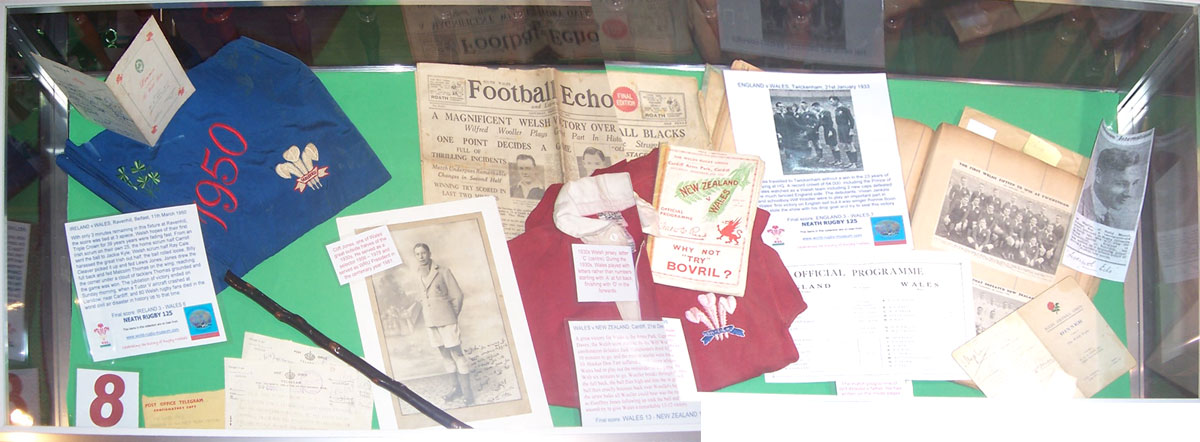
CLICK ON THE ABOVE IMAGE TO SEE OUR WALES V NZ 1905 EXHIBIT AT THE NEATH RUGBY 125 EXHIBITION CELEBRATING 125 YEARS OF THE WELSH RUGBY UNION FOUNDED IN NEATH Part of the collection on view at the Neath Rugby 125 exhibition This collection is only available for purchase or hire as part of our World Rugby Museum 'Partner Programme' for more information on our 'Partner Programme' - CLICK HERE |
| 29th November 1924 - WALES 0, NEW ZEALAND 19 (St Helen's, Swansea) |
| 21st December 1935 - WALES 13, NEW ZEALAND 12 (Cardiff Arms Park) |
|
|
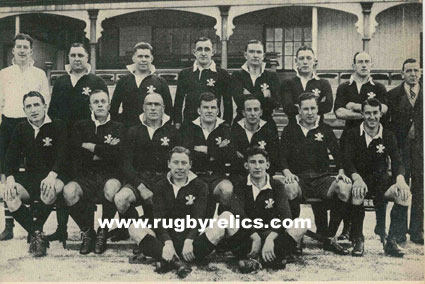
| A great victory for Wales at the Arms Park, captained by Claude Davey, the Welsh team inspired by the Wilf Wooler - Cliff Jones combination defeated Jack Manchester's third All Blacks. Only 10 minutes to go, and the men in scarlet were trailing by 12 pts to 10. Hooker Don Tarr suffered a neck injury which meant that Wales had to play out the remainder of the game with 14 men. With six minutes to go, Wooller breaks through the gap, chips the full back, the ball flies high and into the in goal area, but the ball then cruelly bounces back over Wooller's head. Crashing into the straw bales all Wooller could hear was the roar of the crowd as Geoffrey Jones following up took the ball and scored his second try to give Wales a remarkable 13-12 victory. |
|
BUY AUTHENTIC 1935 WALES V NZ MEMORABILIA AT RUGBY RELICS - CLICK HERE |
|
|
|
CLICK ON THE CENTRE OF THE ABOVE IMAGE TO SEE OUR WALES V NZ 1935 EXHIBIT AT THE NEATH RUGBY 125 EXHIBITION CELEBRATING 125 YEARS OF THE WELSH RUGBY UNION FOUNDED IN NEATH |
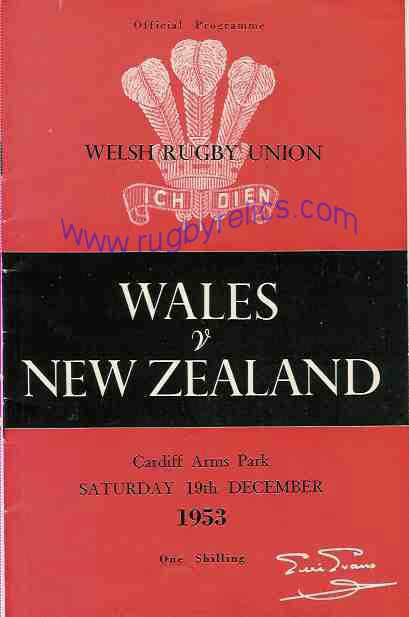
| 19th December 1953 - WALES 13, NEW ZEALAND 8 (Cardiff Arms Park) |
|
The All Blacks were hoping to make it 3rd time lucky in the nation's capital. In 1905 & 1935 they had been beaten (the 1924 win by the All Black Invincibles was at Swansea) at the Arms Park, was this to be the one? A Welsh defeat looked ominous when 10 minutes into the second half centre Gareth Griffiths left the field with a badly dislocated shoulder. The All Blacks led 8 - 5 at the time. With 15 minutes remaining against medical advice Griffiths returned, this immediately fired up the home team's forwards who managed to win a penalty which Gwyn Rowlands converted. It was now 8 points a piece. The battle raged and giant Welsh wing forward Clem Thomas found himself hemmed in on the touchline by All Blacks, he hoofed the ball way across field for Olympic sprinter Ken Jones to scoop up the ball and race in for the decisive try. A mighty roar ensued as the 56,000 crowd celebrated another glorious victory over New Zealand's finest. |
|
BUY AUTHENTIC 1953 WALES V NZ MEMORABILIA AT RUGBY RELICS - CLICK HERE |
| 21st December 1963 - WALES 0, NEW ZEALAND 6 (Cardiff Arms Park) |
| 11th November 1967 - WALES 6, NEW ZEALAND 13 (Cardiff Arms Park) |
| 31st May 1969 - NEW ZEALAND 19, WALES 0 (Lancaster Park, Christcurch) |
| 14th June 1969 - NEW ZEALAND 33, WALES 12 (Eden Park, Auckland) |
| 2nd December 1972 - WALES 16, NEW ZEALAND 19 (Cardiff Arms Park) |
| 11th November 1978 - WALES 12, NEW ZEALAND 13 (Cardiff Arms Park) |
| 1st November 1980 - WALES 3, NEW ZEALAND 23 (Cardiff Arms Park) |
| 14th June 1987 - NEW ZEALAND 49, WALES 6 (Ballymore, Brisbane) |
| 28th May 1988 - NEW ZEALAND 52, WALES 3 (Lancaster Park, Christcurch) |
| 11th June 1988 - NEW ZEALAND 54, WALES 9 (Eden Park, Auckland) |
| 4th November 1989 - WALES 9, NEW ZEALAND 34 (Cardiff Arms Park) |
| 31st May 1995 - NEW ZEALAND 34, WALES 9 (Ellis Park, Johannesburg) |
| 29th November 1997 - WALES 7, NEW ZEALAND 42 (Wembley Stadium, London) |
| 23rd November 2002 - WALES 17, NEW ZEALAND 43 (Millennium Stadium, Cardiff) |
| 21st June 2003 - NEW ZEALAND 55, WALES 3 (Waikato Stadium, Hamilton) |
| 2nd November 2003 - NEW ZEALAND 53, WALES 37 (Telstra Stadium, Sydney) |
| 20th November 2004 - WALES 25, NEW ZEALAND 26 (Millennium Stadium, Cardiff) |
| 5th November 2005 - WALES 3 v NEW ZEALAND 41 (Millennium Stadium, Cardiff) |
| 25th November 2006 - WALES 10 NEW ZEALAND 45 (Millennium Stadium, Cardiff) |
|
Thank you for visiting this page. If you are able to contribute any information for this page, please email us at info@rugbyrelics.com |
|
This page is supported by CLICK HERE to be taken to the Digital Systems UK website
|
|
The World Rugby Museum would like to thank Digital Systems UK Ltd for supporting this page. To learn more about supporting the exhibits at the World Rugby Museum - CLICK HERE |
|
The World-Rugby-Museum is hosted by the Rugby Gifts & Rugby Relics websites |