|
the teams.......................
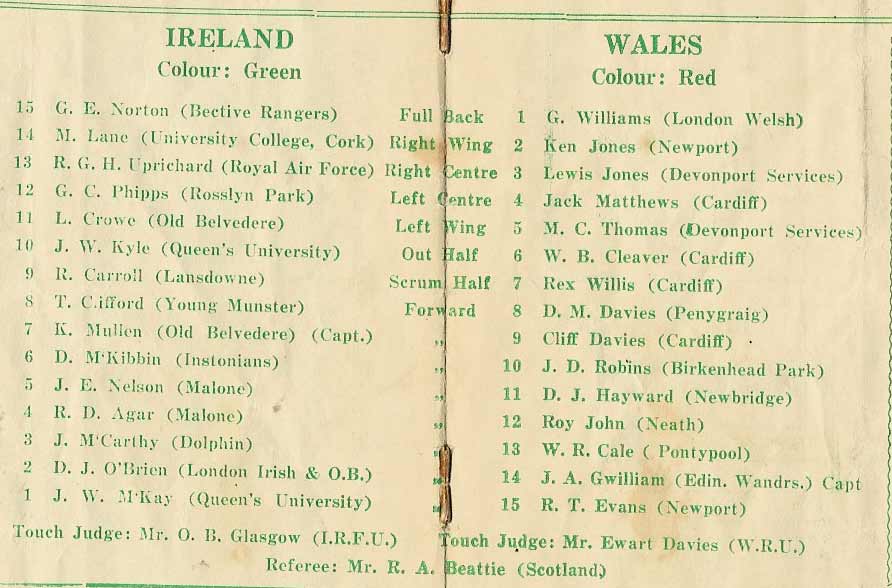
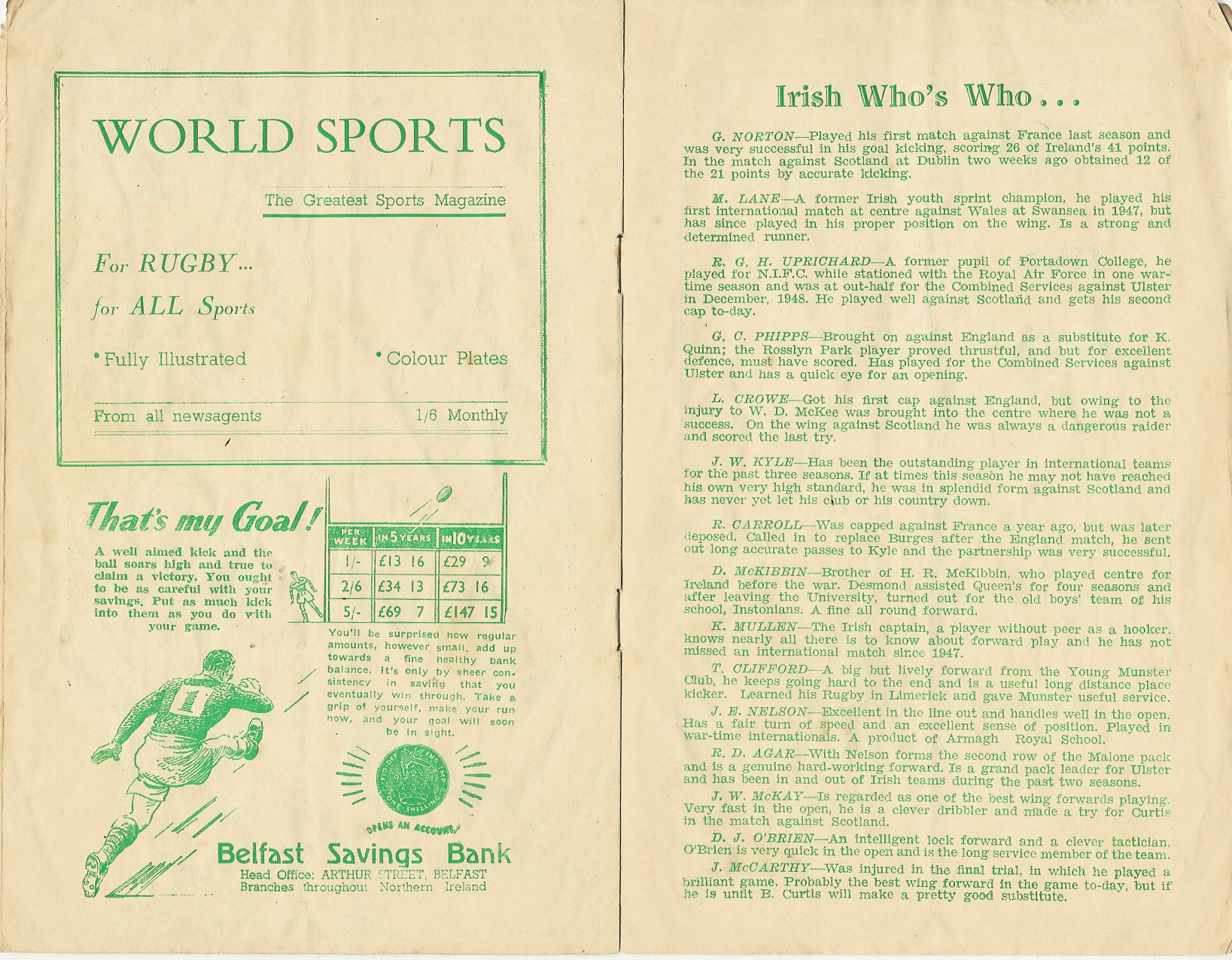
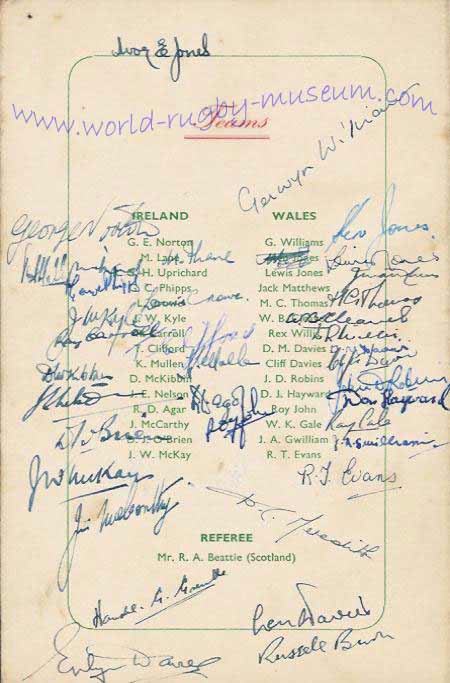
The teams as shown in the match programme |
The 1950 Welsh Triple Crown & Llandow Air Disaster
|
The weekend of 11th & 12th March 1950 was one of the most disturbing ever for the the people of Wales. Taken from the high of winning Wales' 8th Triple Crown, their first one in 39 years to the low of 78 Welsh supporters losing their lives in the world's worst air disaster, a nation's emotions were thrown into turmoil............................... |
IRELAND v
WALES, Belfast, 11th March 1950
| Under the captaincy of John Gwilliam, Wales arrived at Ravenhill, Belfast with two wins under their belt looking for their first Triple Crown in 39 years. An 11 - 5 victory of England at Twickenham, their first since 1933 and a 12 - 0 victory over Scotland at Swansea put the team in a buoyant mood ready to take on the might of the Irish. Ireland, who were in the middle of their own Golden era were the Triple Crown champions and in their last outing against Wales on home soil, also at Ravenhill they had secured their only Grand Slam in 1948 with a 6 - 3 victory. The scene was set............... |
|
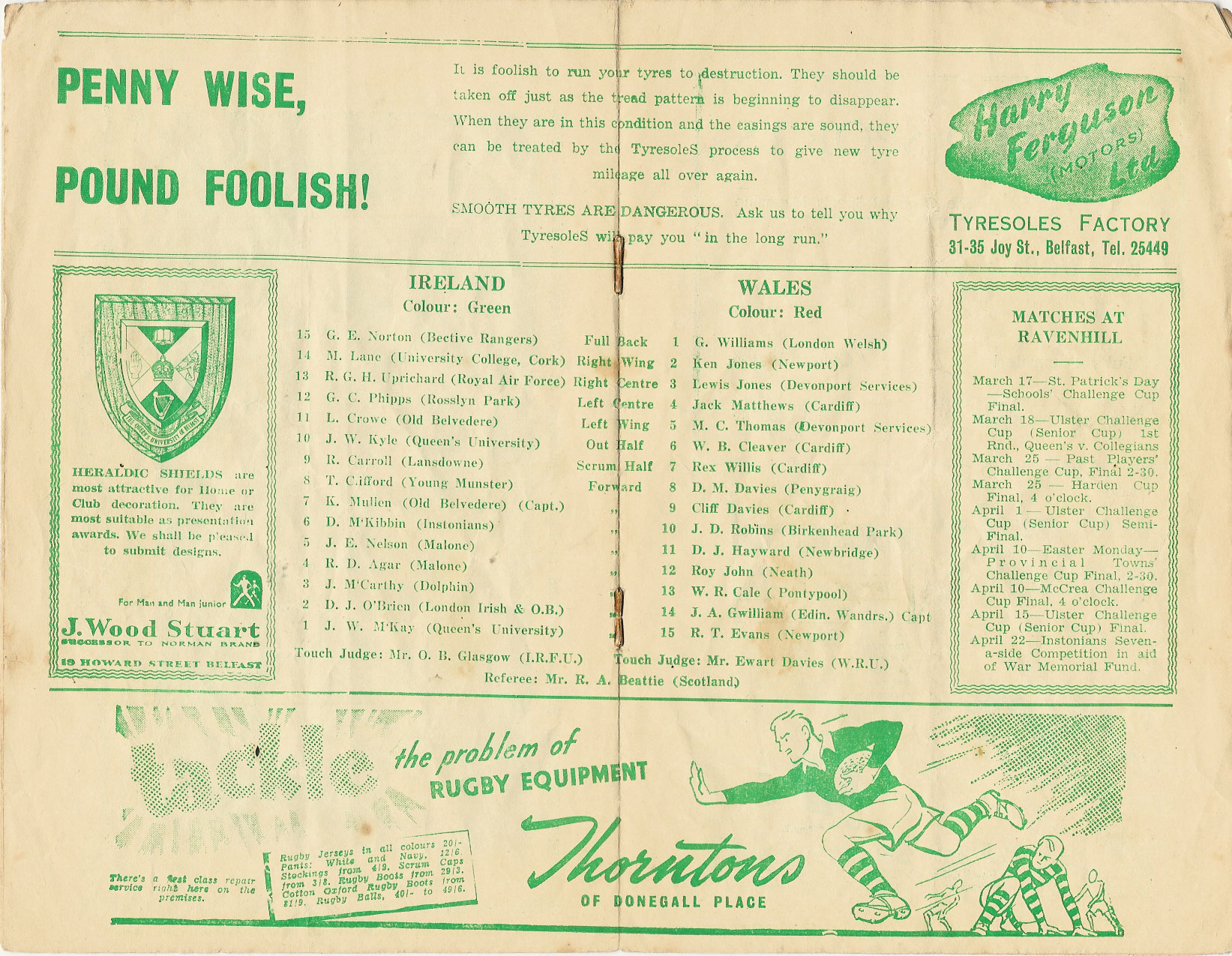
the teams.......................
The teams as shown in the match programme |
|
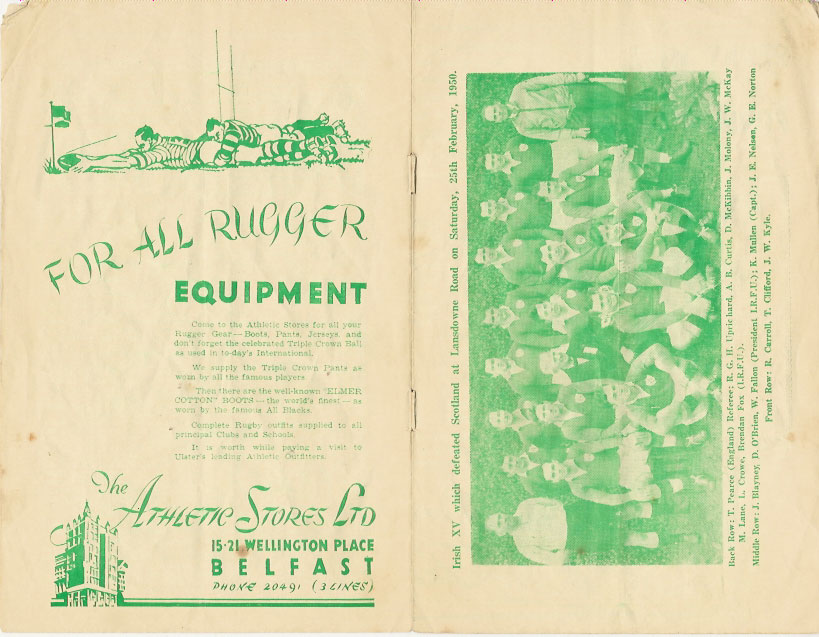
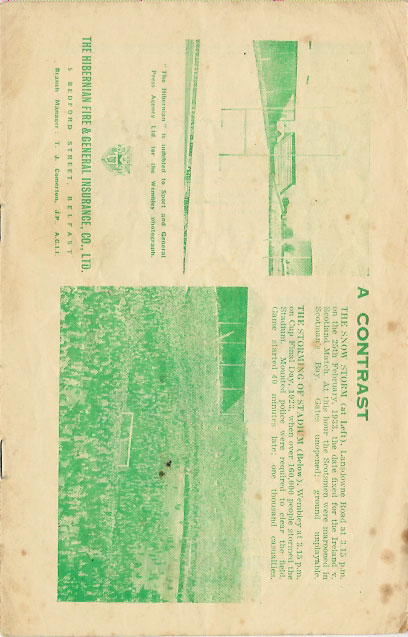
OFFICIAL MATCH PROGRAMME |
|
Please click on the above images to enlarge the photo (WRM-RR-prirwa50) |
|
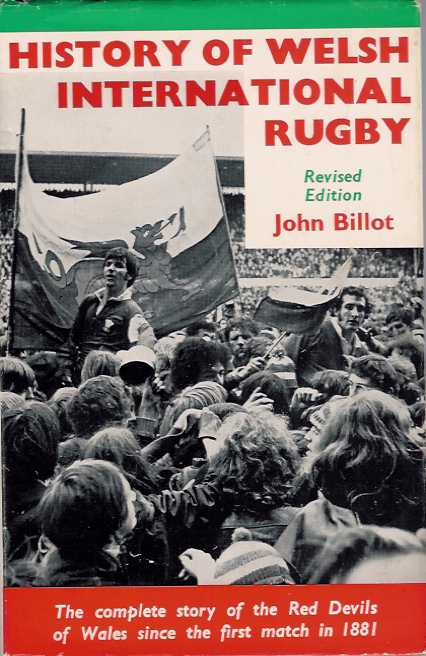
The match....................... a report by John Billot in his book ................
(text from John Billot - "History of Welsh International Rugby" Three
minutes to go. The score: 3-3. Welsh hopes of the Triple Crown after 39 years
were fading. Ireland heeled on their own 25. Jackie Kyle was bound to clear to
touch. But Ray Cale pounced round the scrum to harass Carroll. As the scrum half
desperately shovelled the ball out to Kyle, Cale went with it. What a fearsome
combination for even a fly half of Kyle's quality: a bad pass and a deadly
tackler at the same time. The ball rolled loose, but at least Kyle was spared to
become a missionary in Africa. Cleaver picked up and fed Lewis Jones: the
winning try was taking shape. Lewis Jones, in his new position of centre, drew
full back Norton and sent a long pass swinging out to Malcolm Thomas. There were
15 yards to go as the Welsh wing threw back his head and ran for the Triple
Crown. Corner-flaggers
streamed across like a cloud of locusts. They hit Thomas as he dived for the
corner. Down everyone crashed, corner flag and all. Was it a try? There were
agonising hour- long seconds before referee R A Beattie (Scotland) raised his
arm and Wales had won. If Irish touch judge Ossie Glasgow had signalled that
Thomas had knocked down the flag before grounding the ball there would have been
few Welsh protests. It was a marginal decision either way. There
was no score in the first half. Then a Ken Jones try was cancelled out by George
Norton's penalty goal. It was a tough baptism for new Welsh full back Gerwyn
Williams, but he went on to win 13 caps. The jubilation ended on Sunday morning,
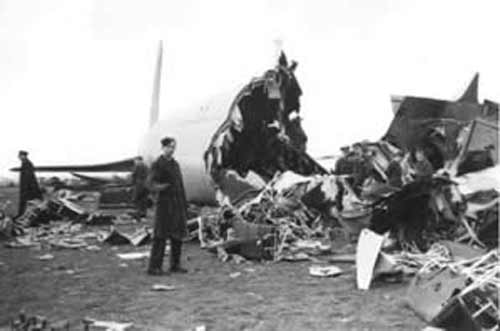
when a Tudor V aircraft crashed at Llandow, near Cardiff; and 80 Welsh rugby
fans died in the worst civil air disaster in history up to that time. It was a
shadow across the first Triple Crown triumph since 1911. So for the eighth time
Wales had won the honour. Ireland: G W Norton (Bective); NI Lane (Univ. Coll., Cork), R J H Uprichard (RAF), G C Phipps (Rosslyn Park), L Crowe (Old Belvedere); JW Kyle (Queen's Univ., Belfast), R Carroll (Lansdowne); T Clifford (Young Munster), K D Mullen (Old Belvedere, capt.), D McKibbin (Queen's Univ., Belfast), J E Nelson, R Agar (Malone), J W McKay (Queen's Univ., Belfast), D J O'Brien (London Irish), J S McCarthy (Dolphin).
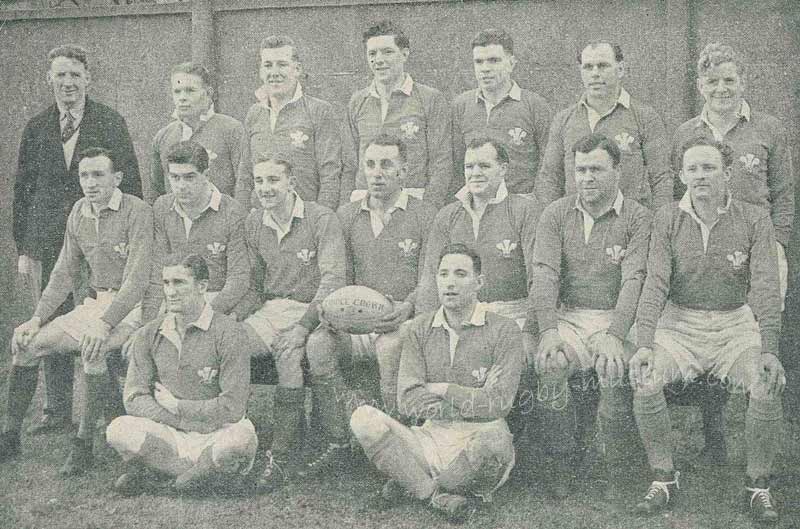
The victorious Welsh team (names below do not match up with this photo) Wales: *Gerwyn Williams (London Welsh); K J Jones (Newport), Lewis Jones
(Devonport
Services), J Matthews (Cardiff), M C Thomas (Devonport Services); W B Cleaver, W
R Willis (Cardiff); J D Robins (Birkenhead Park), D M Davies (Somerset Police),
Cliff Davies (Cardiff), Roy John (Neath), Don Hayward (Newbridge), W R Cale (Pontypool),
J A Gwilliam (Edinburgh Wands., capt.), R T Evans (Newport). |
|
|
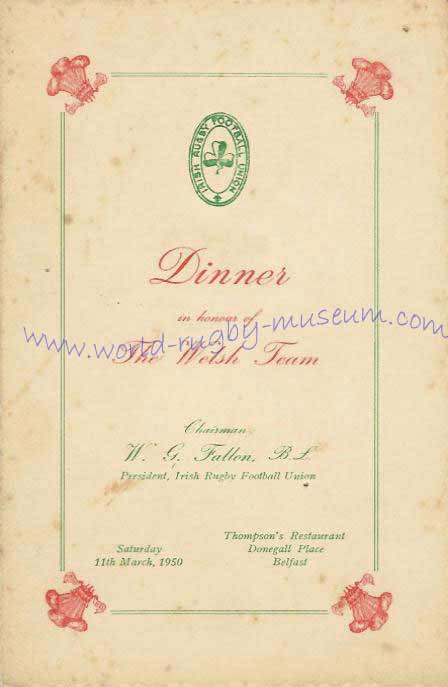
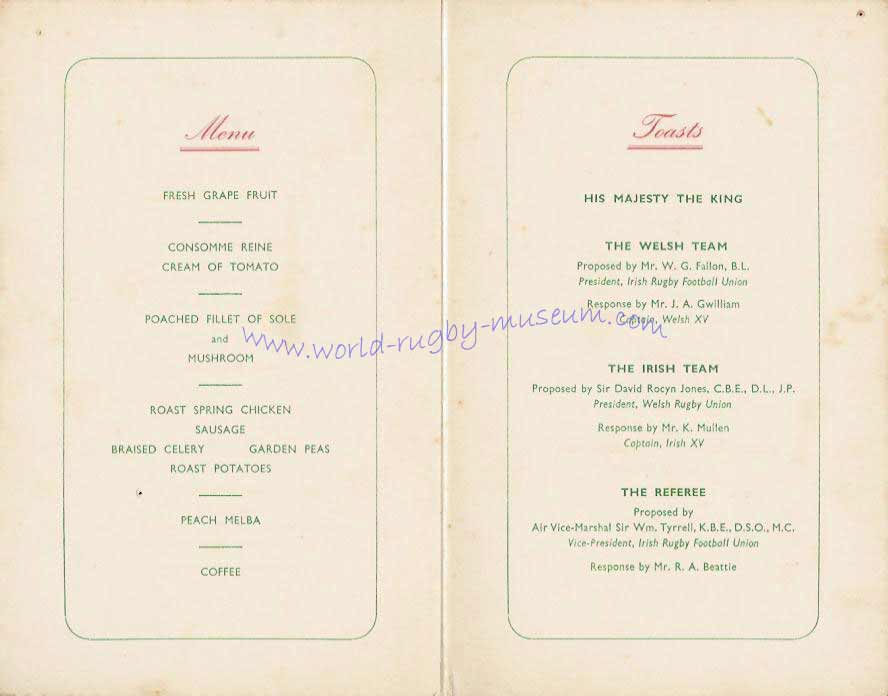
AUTOGRAPHED DINNER MENU This autographed dinner menu is for the post match function held at Thompson's Restaurant in Belfast. This is the personal copy of Ivor Jones (1930 British Lions, 16 Welsh caps, WRU President 1968/9) who was a selector at the time. His autograph appears on the top of the back cover, it is also autographed by both sides and 5 other players/officials.
(WRM-0133) |
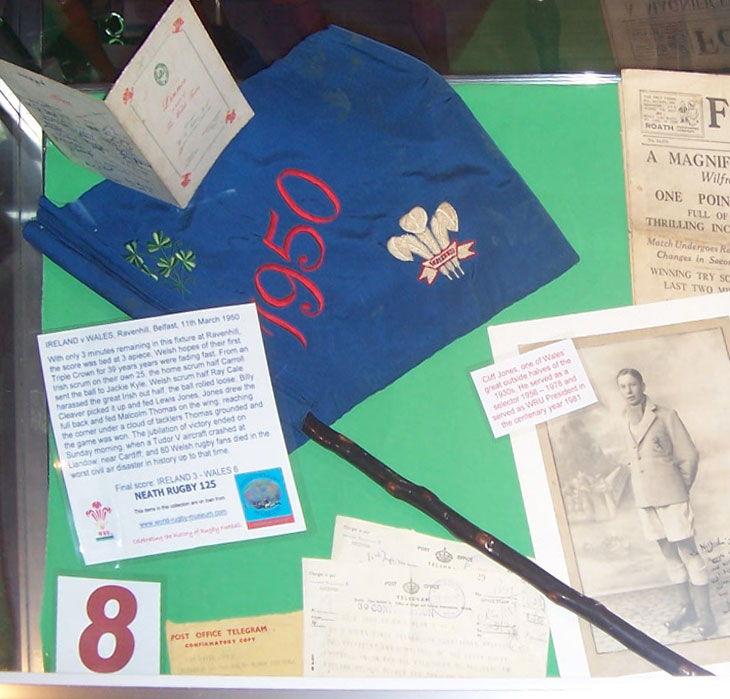
Ireland v Wales touch flag, presented to WRU President, Sir David Rocyn Jones at the post match function (WRM-0269)
CLICK HERE or on the above image to see the rest of the Neath Rugby 125 Exhibition
|
|
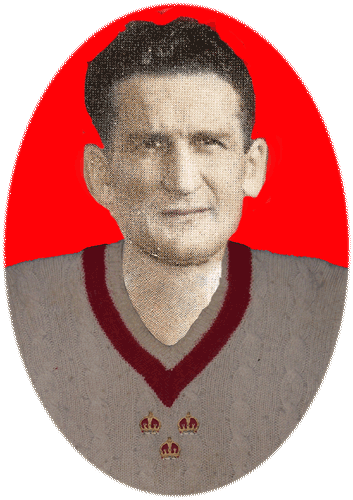
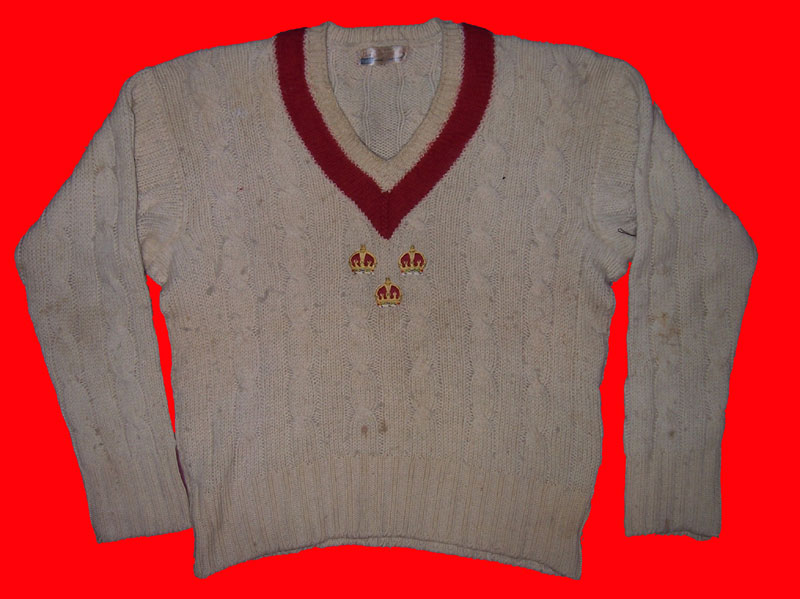
TRIPLE CROWN SWEATER This Triple Crown sweater was awarded to scrum half Rex Willis. The Cardiff man played his first international against England at the beginning of the 1950 Grand Slam season. He went on to win a further 20 caps, captaining the side on two occasions. He toured New Zealand & Australia with the 1950 British Lions playing a test match against both the All Blacks and Wallabies.
It is not known which triple crown this sweater was awarded for, either 1950 or 1952. Willis played in all 4 of the 1950 matches and two from the 1952 Grand Slam. (WRM-0702) |
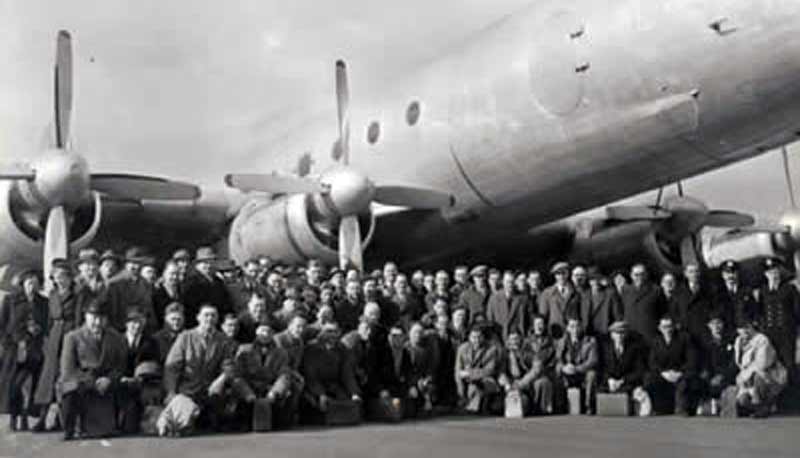
LLANDOW AIR DISASTER - 12th March 1950
|
|
|
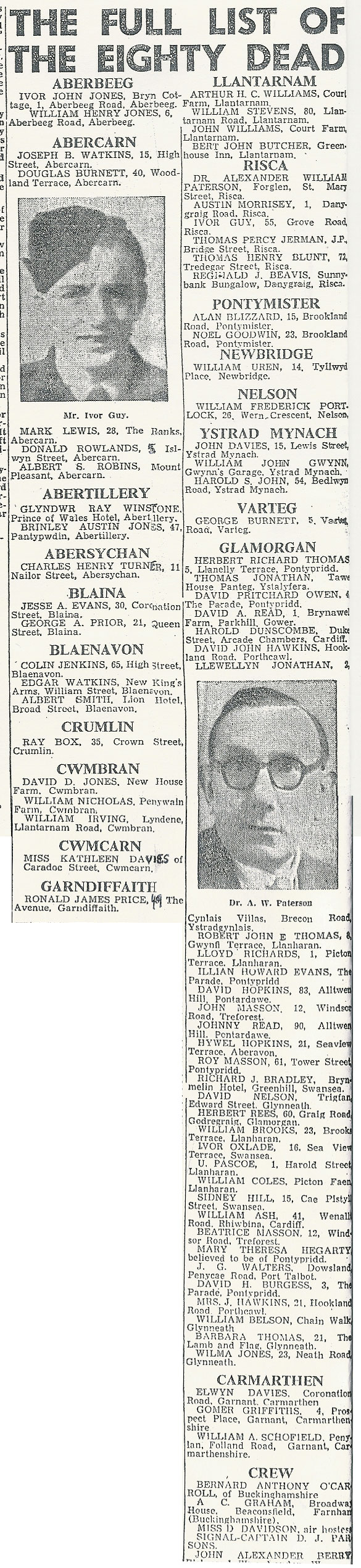
FATALITIES
FROM
THE COUNTY OF MONMOUTHSHIRE ABERBEEG - IVOR JOHN JONES, WILLIAM HENRY JONES. ABERCARN
- JOSEPH B. WATKINS, DOUGLAS BURNETT, MARK LEWIS, DONALD ROWLANDS,
ALBERT S. ROBINS. ABERTILLERY
- GLYNDWR ABERSYCHAN
- CHARLES HENRY
TURNER BLAINA
- JESSE
A. EVANS, GEORGE A PRIOR, BLAENAVON
- COLIN
JENKINS, EDGAR WATKINS, ALBERT SMITH, CRUMLIN
- CWMBRAN
- DAVID
D. JONES, WILLIAM NICHOLAS, WILLIAM IRVING. CWMCARN
- Miss
KATHLEEN DAVIES. GARNDIFFAITH
- RONALD
JAMES PRICE. LLANTARNAM
- ARTHUR.C.
WILLIAMS, WILLIAM STEVENS, JOHN WILLIAMS, BERT JOHN BUTCHER. RISCA
- Dr
ALEXANDER WILLIAM PATERSON, AUSTIN MORRISEY, IVOR GUY, THOMAS PERCEY
JERMAN, THOMAS HENRY BLUNT, REGINALD J. BEAVIS PONTYMISTER
- NEWBRIDGE
- WILLIAM
UREN NELSON
- WILLIAM
YSTRAD
MYNACH - JOHN
DAVIES, WILLIAM JOHN GWYN, HAROLD S. JOHN VARTEG
- GEORGE
BURNETT. FROM THE COUNTY OF GLAMORGAN HERBERT
RICHARD THOMAS, THOMAS JOHATHAN, DAVID PRITCHARD OWEN, DAVID A READ,
HAROLD DUNSCOMBE, DAVID JOHN HAWKINS, LLEWELLYN JONATHAN, ROBERT JOHN E.
THOMAS, LLOYD RICHARDS, ILLIAN HOWARD EVANS, DAVID HOPKINS, JOHN
MASSON, JOHNNY READ, HYWEL HOPKINS, ROY MASSON, RICHARD J.
BRADLEY, DAVID NELSON, HERBERT REES, WILLIAM BROOKS,
IVOR OZLADE, U. PASCOE, WILLIAM COLES, SIDNEY HILL,
WILLIAM
FROM THE COUNTY OF CAMARTHENSHIRE ELWYN
DAVIES, GOMER GRIFFITHS, WILLIAM A SCHOFIELD. THE CREW BERNARD
ANTHONY O'CARROLL, A.C. GRAHAM, Miss D. DAVIDSON ,
Signal-Captain (Pilot) D. J. PARSONS, JOHN ALEXANDER BERRY. SURVIVORS MELVILLE
THOMAS of Llanharan , HANDEL ROGERS, GWYN ANTHONY,both of Llanelly |
******
 |
 |
 |
|
Telegram from Sir Williams Tyrell, Vice President of the Irish RFU to Sir David Rocyn Jones, President of the WRU (WRM-0134) |
Telegram from the Irish RFU to Sir David Rocyn Jones, President of the WRU (WRM-0135) |
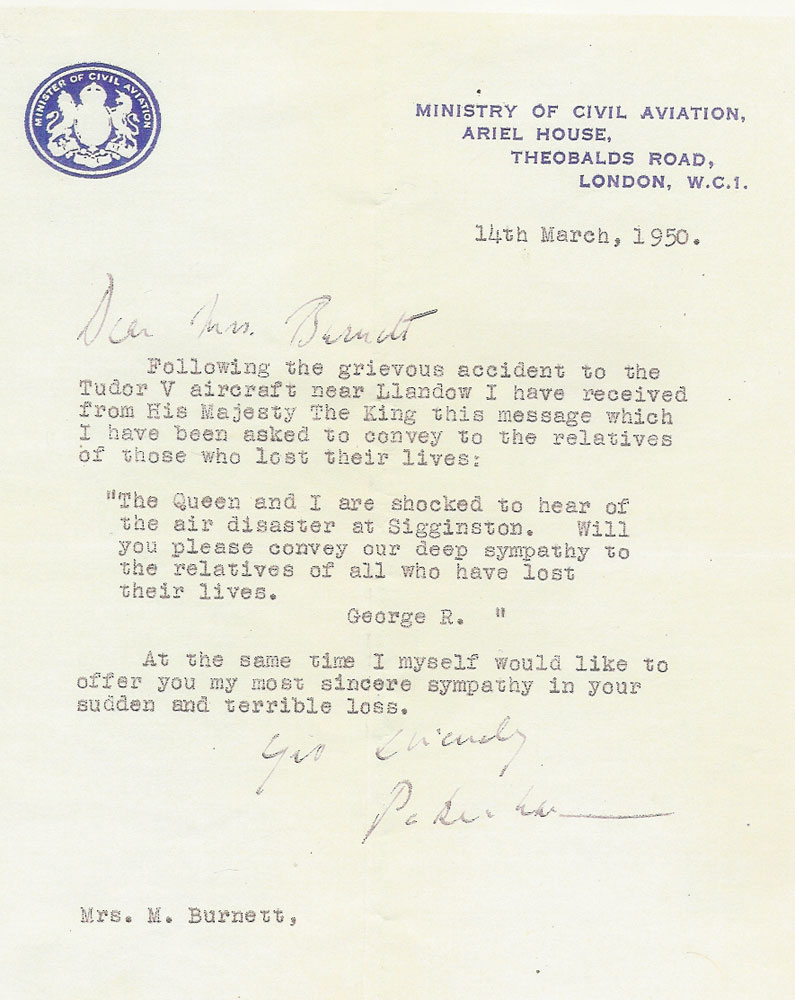
A letter of condolence from the Ministry of Civil Aviation in London with a message from his Majesty the King. This letter was sent to Mabel Burnett, the mother of Douglas Burnett of Abercarn. |
******
|
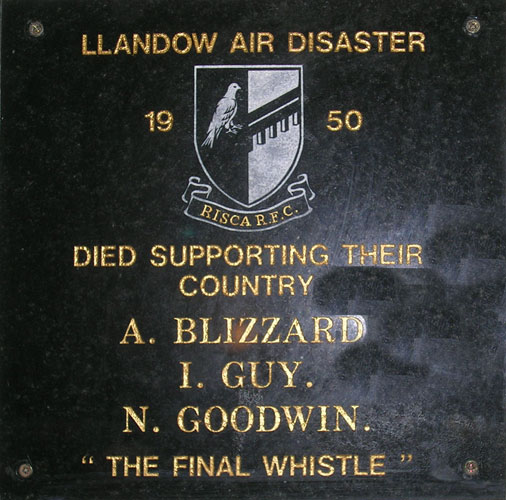
RISCA RFC Six persons from Risca RFC were unfortunate to be on the fateful flight from Ireland. Three players – Alan Blizzard, Ivor Guy and Noel Goodwin. Also, three supporters of Risca RFC – Percy Jerman, Dr. Paterson** and Reg Beavis. At Risca RFC, there is a commemorative plaque in memory of the players of the club who lost their lives.
24/7/15 - I received an email from Douglas, the grandson of Dr Paterson............... "Dr Paterson was my grandfather although I never knew him as I was born in 1952. My mother swore she would never fly but did so to attend my wedding in Northern Ireland in 1979. My only other link to the story is that I was in school with the son of one of the survivors, Handel Rogers. |
|
MEMORIES OF THE DISASTER |
|
|
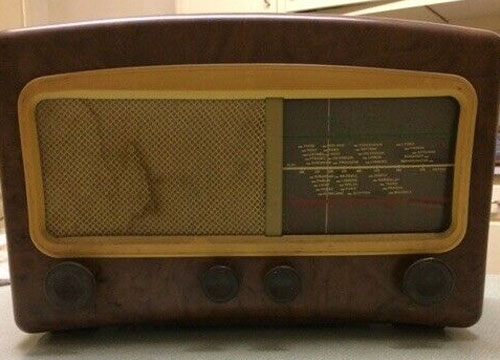
David was 15 and picked up the distress call on his home made headphones via the family Cossor wireless. over to David for the full story.........
|
|
|
Hello, My name is David. In 1950 I was 15,and mad on listening to the Short Wave Bands on our household Cossor Wireless,in
Abercynon. However the bits of Morse..RT..and foreign voices did not go down too well with Mam and Dad so after reading an American Radio Mag.I hit on an idea to listen in peace by plugging a pair of ex.Army headphones I bought in Pontypridd Market into the extension loudspeaker socket. From the same ex.Army junk stall,I bought a reel of aerial wire and an earth spike.Fair play to Dad he went along with my idea and did his best to cut off the large Bakerlite and brass Army plug,off the military headphones, and by carefully soldering a Woolworths plug on,it worked. That Sunday I was slowly scanning the wave bands, when I clearly heard a distress call from an aircraft approaching Llandow, aerodrome. I immediately called Dad,who preferred to listen to the BBC HOME SERVICE, but it did not carry the news until much later. Sadly,my story was not taken seriously, so much so that when BBC.RADIO WALES asked for stories of listening to the kitchen wireless, that part was edited out? Three years later when I was called up for Army National Service in the Royal Signals I finally had the chance to roam the World Over, on some Wonderfull Radios, but it never equalled the excitement of that Sunday in 1950. With regards. David |
|
|
We checked with David if we had the right type of Cosser and he supplied us with some more info and an additional story about his contact with the Neath player Billy Boston who went of to become one of the greatest rugby league players of all time..........
|
|
|
Thanks for the reply to my childhood memory. As for the Cossor wireless, ours was a floor standing
model, which as the years went by got shorter and shorter.
Come my 18th birthday I was called up for Army National Service in the Royal Signals, and on several occasions I travelled from Catterick Yorks. to Cardiff with Billy Boston. Billy was part of the all beating Army Rugby team at 1TR and by chance Brian Gabittas of Hunslett, was attending the same Techs. Course as me. My only contact with Billy came about during the compulsory cross country runs so he must have been a PTI. During a trip home to the Cynon Valley, via Cardiff, Billy had with him a lad from the West African Defence Force who must have been attending a Signals Course?? As he was unable to go home for leave Billy's Mam looked after him in Tiger Bay. Must go now its time for my Horlicks................ With regards. David (Taff***) Watkins Porth. *** nearly every Welshman in the British Armed Forces outside of the traditional Welsh Regiment's has the nickname 'Taff'. |
|
******
|
Acknowlegements Dai Richards - World Rugby Museum, South Wales Police - Llandow Air Disaster photos, John Billot - History of Welsh International Rugby, Colin Wilks - Chairman Risca RFC, Anne Chambers (relation to passenger Kathleen Davies of Cwmcarn), Ceri Pugh. Alison Burnett (grand-niece of Douglas Burnett of Abercarn), David from Abercynon,
|
******
|
Thank you for visiting this page. If you are able to contribute any other stories, photos or information to this page, please CLICK HERE to email us. |
******
|
... ...
|
The World-Rugby-Museum is hosted and supported by Rugby Relics
|